
Charter jet Chicago Executive basics
Charter jet Chicago Executive means KPWK, the close-in field at 647 ft elevation. Its longest runway runs 5,001 ft, which shapes which aircraft can depart on a hot July afternoon. This guide covers runways, FBOs, density altitude and access.
Charter jet Chicago Executive is the practical answer for a lot of travelers headed to the North Shore and northwest suburbs. The field sits at 647 ft elevation with a 5,001-ft longest runway, and three FBOs on the property handle general aviation traffic. Because it is closer to downtown than the big airports, a charter jet Chicago Executive arrival can cut the ground transfer after you land. Flights are arranged through charter brokers and flown by independent operators; we are a broker acting as your agent, not an aircraft operator.
The airport's layout matters more than its reputation. With a single long runway and parallel taxiways, departures are straightforward in cool weather. A 5,001-ft runway at 647 ft elevation sets the performance limit on warm days. That is a real constraint, not a technicality. On a July afternoon the density altitude can reach 2,300 ft, so a lightly loaded midsize jet climbs fine while a fully fueled heavy may need a different plan. Pilots flying here know the difference between a cool morning departure and a 3 p.m. takeoff in August.
For a city site like this, the value is location and choice. Chicago Executive serves the northern suburbs and the lakefront corridor, and it gives you a second option when O'Hare or Midway is congested. You are not limited to one field. The right charter jet Chicago Executive quote may actually route through Gary/Chicago International (GYY) or another airport if that fits your trip better. We compare aircraft and operators and present the estimate; the operator holds operational control under FAA Part 135 rules.
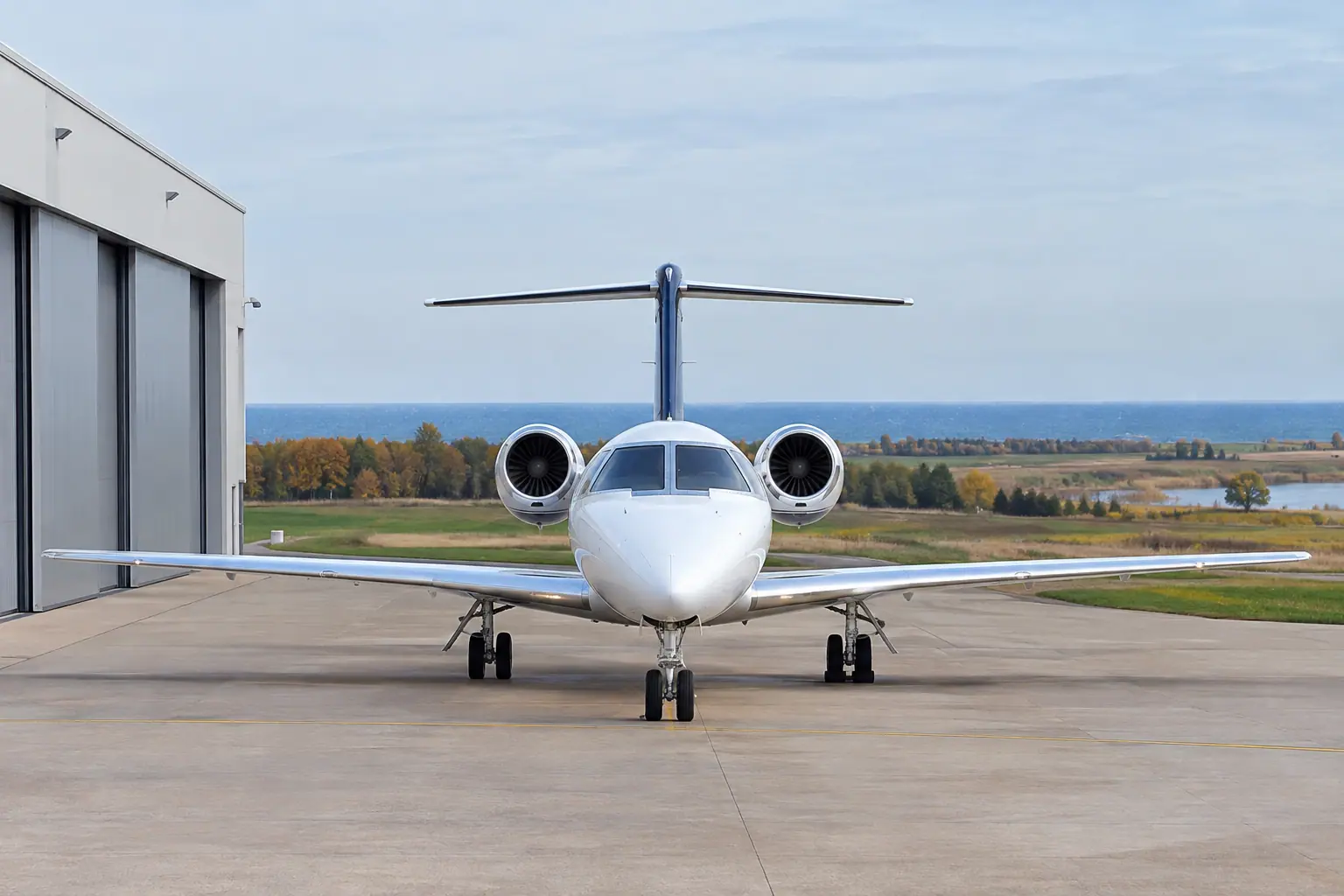
Runway length and performance at KPWK
KPWK's longest runway is 5,001 ft at 647 ft field elevation, and that combination drives takeoff planning. The 5,001-ft runway handles most light and midsize jets, but payload and temperature matter. On a standard day a light jet with four passengers is comfortable. On a hot day with full tanks and a long leg, the same aircraft may need a fuel stop or a different runway. Pilots calculate density altitude before every departure because the margin shrinks as the mercury rises. If your trip is a long one out of Chicago Executive, then the operator may plan a fuel stop so the aircraft can depart within limits. That is normal planning, not a problem with the airport.
| Rwy | Length | Width | Surface |
|---|---|---|---|
| 16/34 | 5,001 ft | 150 ft | Asphalt |
| 12/30 | 4,415 ft | 75 ft | Asphalt |
Ground handling at Chicago Executive
Three FBOs serve Chicago Executive: Atlantic Aviation, Signature Aviation and Ascension FBO Network. Having three FBOs at KPWK gives operators more choice on parking, fuel and passenger handling. Which one your flight uses depends on the operator's agreement and where the aircraft is based or parked. For passengers, the practical difference is the lobby, the ramp access and the drive from the entrance. Ask which FBO your flight will use so your car service goes to the right building.
Ground handling is arranged by the operator, not by us as the broker. If you need a specific FBO for a meeting or a car pickup, say so when you request the quote and we will pass it along. International arrivals need CBP clearance, and that is arranged in advance rather than assumed at a general aviation field.
Who Chicago Executive works best for
- Travelers headed to the North Shore, northwest suburbs or lakefront who want a shorter drive after landing than O'Hare or Midway requires.
- Business trips to downtown Chicago where a close-in general aviation field saves ground time on both ends.
- Light and midsize jet charters where the 5,001-ft runway and 647-ft elevation match the aircraft's performance.
- Trips planned for cool mornings or shoulder seasons, when density altitude is low and payload margins are widest.
| Class | Typical runway need | Here |
|---|---|---|
| Turboprop | 3,300 ft+ | Works |
| Light jet | 4,000 ft+ | Works |
| Midsize jet | 5,000 ft+ | Works |
| Super-midsize jet | 5,200 ft+ | Payload-restricted |
| Heavy jet | 5,600 ft+ | Payload-restricted |
Weather and density altitude by season
July is the hottest month here, with an average high of 81 F and a density altitude around 2,300 ft; the peak at 115 F reaches 2,800 ft. Summer density altitude at Chicago Executive affects payload more than winter cold ever does. In January the average high is 32 F and density altitude runs about minus 1,000 ft, so aircraft perform well and runways feel long. Spring and fall sit in between, with April at 55 F and October at 62 F.
Wet days matter too. The airport sees roughly 12 wet days in July and 12 in April, so afternoon thunderstorms can delay departures. If a line of storms crosses the field, then the operator waits or reroutes rather than pushing a flight into it. Pilots plan around convective weather in summer and snow in winter. None of this is unusual for the Midwest, but it is why a good quote accounts for the season and the time of day.
| Month | Avg high | Wet days | Density altitude |
|---|---|---|---|
| Jan | 32°F | 10 | -1,000 ft |
| Feb | 36°F | 9 | -700 ft |
| Mar | 45°F | 11 | -100 ft |
| Apr | 55°F | 14 | 500 ft |
| May | 66°F | 12 | 1,300 ft |
| Jun | 77°F | 12 | 2,000 ft |
| Jul | 81°F | 12 | 2,300 ft |
| Aug | 80°F | 11 | 2,200 ft |
| Sep | 75°F | 10 | 1,900 ft |
| Oct | 62°F | 12 | 1,000 ft |
| Nov | 48°F | 8 | 100 ft |
| Dec | 39°F | 9 | -500 ft |
Getting to and from the airport
Chicago Executive sits in the northwest suburbs, and the drive to downtown depends on traffic more than distance. KPWK is a closer-in field than O'Hare for many North Shore and suburban addresses, which is the main reason travelers ask for it. Your FBO choice changes the entrance and the pickup point, so confirm the building before you book a car. If you are connecting to a commercial flight at O'Hare, then allow extra time because you are crossing the metro rather than transferring inside one airport. For international legs, CBP clearance is arranged ahead of time through the operator.
Private jet routes via Chicago
These 6 private jet routes span 231 to 1,528 nautical miles, with one-way light jet estimates ranging $4,000 to $27,500.


FAQs for this airport
How long is the runway at Chicago Executive for a charter jet?
The longest runway at KPWK is 5,001 ft, with a field elevation of 647 ft. That length works for most light and midsize jets, but density altitude changes the calculation. On a hot July day the density altitude can reach 2,300 ft, and at a 115 F peak it reaches 2,800 ft, so a heavy aircraft may face payload limits or a fuel stop.
Which FBOs operate at Chicago Executive?
Three FBOs serve the field: Atlantic Aviation, Signature Aviation and Ascension FBO Network. Your operator chooses one based on its own arrangements, so ask which building your flight will use. That matters for car pickups and for anyone meeting you on arrival. We can pass a preference along when we request quotes, but the operator makes the final call.
Is Chicago Executive a good alternative to O'Hare for private flights?
It often is, because KPWK is a general aviation field with three FBOs and less congestion than O'Hare. O'Hare's longest runway is 13,000 ft, so it handles aircraft that KPWK cannot, while Chicago Executive's 5,001 ft suits many light and midsize jets. The right choice depends on your aircraft, your destination and where you are staying.
How does summer heat affect departures from KPWK?
July averages a high of 81 F with a density altitude near 2,300 ft. Warm air reduces lift and engine performance, so a jet that departs comfortably in January at about minus 1,000 ft density altitude may be payload-limited in July. Pilots plan fuel and passenger loads around that, and a long leg may include a fuel stop.
What does a charter jet Chicago Executive quote include?
A quote typically covers aircraft, crew and standard operating costs, with estimates for taxes and fees depending on the trip. Prices are estimates, not final invoices, because fuel and handling vary. We act as your agent under DOT Part 295 rules and compare operators; the flight itself is flown by an FAA Part 135 operator that holds operational control.
Can I fly internationally from Chicago Executive?
Yes, with planning. International departures and arrivals need CBP clearance arranged in advance, and the operator handles that as part of the trip. Not every aircraft at KPWK is set up for international legs, and the 5,001-ft runway may limit range with a full load. Tell us the destination when you request the quote so the right aircraft is matched.